
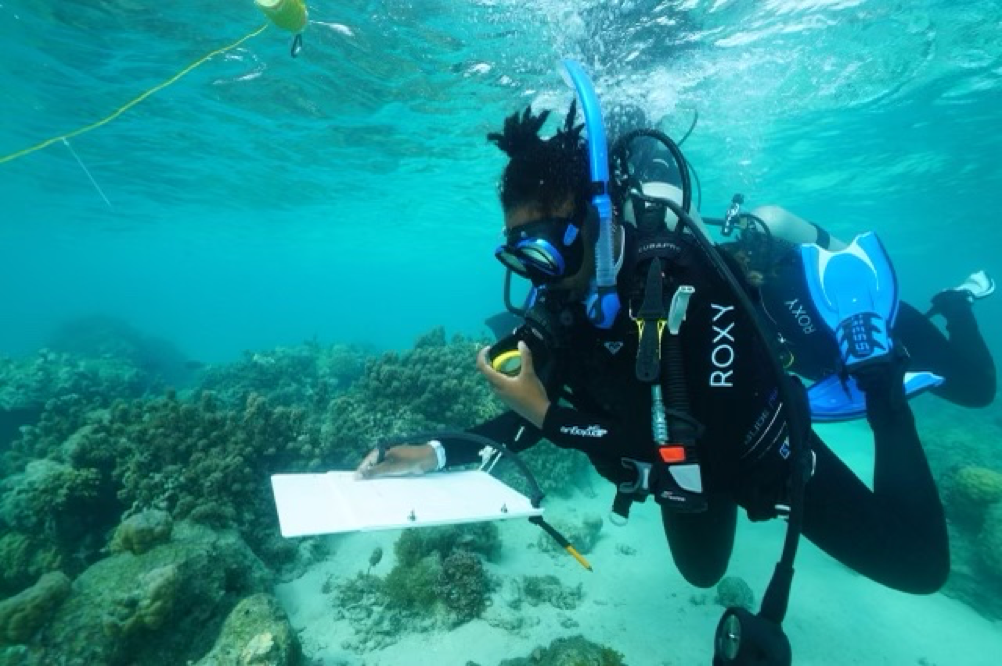
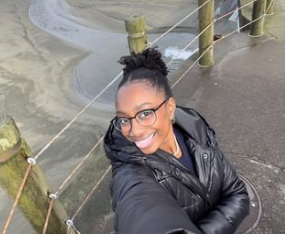
My path to becoming a fisheries scientist was not always clear. I began my undergraduate career as a biology major on the pre-medical track because, growing up, I rarely saw Black marine scientists represented in the field. Without visible examples, marine science didn't initially feel like a realistic career path. That changed after taking ecology-focused courses and volunteering as both a teaching and research assistant, experiences that revealed how deeply I connected with environmental science and research. That realization led me to switch my major to Marine and Environmental Science during my undergraduate studies.
I attended Hampton University, a Historically Black College and University (HBCU), where I felt academically supported and intellectually inspired. Through research opportunities and mentorship, my interest sharpened toward fisheries science and the conservation of vulnerable marine species. After graduating, I pursued a research-based graduate program and am now a graduate student at Oregon State University studying Fisheries, Wildlife, and Conservation Sciences.
My Research Focus
My research focuses broadly on the early life history, energetics, and climate vulnerability of Caribbean large reef predators that are ecologically, economically and culturally important. This includes Nassau Grouper (Epinephelus striatus), Tiger Grouper (Mycteroperca tigris), and Yellowfin Grouper (Mycteroperca venenosa). Much of my work centers on understanding how environmental change affects larval development, survival, and recruitment. Because early life stages are often the most sensitive to environmental stress, this research is critical for informing conservation strategies and fisheries management.
Nassau Grouper, one of my primary study species, is a large predatory reef fish native to the tropical and subtropical western North Atlantic. It is listed as Threatened under the U.S. Endangered Species Act and Critically Endangered by the IUCN. Adults travel long distances to form spawning aggregations between November and February around the full moon. Historically, these aggregations contained thousands to tens of thousands of fish, making them biologically spectacular, but also highly vulnerable. Targeted fishing at aggregation sites has caused widespread population declines, with research showing that nearly one-third of grouper spawning aggregations have disappeared due to overfishing.
Fieldwork and Conservation
My fieldwork is conducted in partnership with the Grouper Moon Project (https://www.reef.org/programs/grouper-moon-project-protecting-caribbean-icon), one of the Caribbean's most successful fish conservation initiatives. The project has supported the recovery of Nassau Grouper populations in the Cayman Islands, particularly at the west end of Little Cayman, which hosts the largest known remaining spawning aggregation for this species. Studying this site provides a rare opportunity to investigate reproductive ecology, larval traits, and conservation outcomes in a recovering population.
For example, mapping often reveals that pollution hotspots align closely with:
- River mouths and dense urban areas
- Industrial ports and shipping lanes
- Regions lacking waste management infrastructure
Those insights allow researchers and policymakers to move from reactive cleanup to proactive prevention.
Navigating Challenges and Building Community
While my academic path has been exciting, it has also required resilience. I began graduate school during the height of the global pandemic, when fieldwork was uncertain and travel restrictions delayed research timelines. At the same time, I transitioned from an HBCU environment to a predominantly white institution, which brought new challenges. Feelings of isolation were real, especially given the limited racial diversity in marine science and the fact that Black scientists remain significantly underrepresented in STEM graduate programs nationwide.
Rather than allowing those challenges to define my experience, I focused on building community and creating solutions. Organizations such as Black in Marine Science (BIMS), Black Women in Ecology, Evolution, and Marine Science (BWEEMS), and the Black Graduate Student Association helped me find belonging, mentorship, and collaboration. These communities not only supported my personal well-being but strengthened my scientific productivity and confidence.
Science Communication and Advocacy
Alongside my academic work, I have developed a parallel career in science communication and digital media strategy. I serve as a social media manager and content strategist for organizations including Black in Marine Science, while also running my own platform, JML Social Media Services, where I help brands, nonprofits, and scientists communicate their work effectively. Through social media, public speaking, and educational content, I aim to make marine science more accessible, inclusive, and visible.
Sharing my journey online connected me with students and aspiring scientists around the world who felt the same isolation I once experienced. That realization transformed how I view my role as a scientist. I am not only conducting research; I am also helping build pathways for others to enter and thrive in this field.
Looking Forward
My path was not linear, and it certainly was not easy. But every step, from switching majors, to navigating graduate school during a pandemic, to building community in spaces where representation is limited has contributed to who I am today: a fisheries scientist committed not only to advancing marine conservation, but also to transforming who gets to participate in it.

